One platform for infrastructure change intelligence and governance.
Understand proposed changes, make evidence-backed decisions, govern authorized execution, and investigate outcomes, all in one platform. Available for Kubernetes on Amazon EKS today.
Every capability carries its claim class: Live running in production for every tenant · Live-proven also exercised end to end by production acceptance and continuous security testing · Supported available where the topology calls for it · Roadmap planned, not shipping · Vision direction, not a feature
Judgment, Permit, Executor, Observation
ChangeGuard AI never lets one stand in for another. That separation is the product.
What it believes
SHIP, HOLD or BLOCK for this change against this environment right now, with the reasons and the evidence it had and did not have. A judgment alone authorizes nothing.
What is authorized
A short-lived, signed, single-use authorization bound to this action, this target, this environment, this approval or policy, and this time window.
What acts
The Cloud Executor or a Local Executor verifies the Permit, consumes it once, and applies exactly the signed action with the least privilege you granted.
What proves what happened
Fresh evidence from the environment, attributed to the change by identity. VERIFIED is a conclusion from observation, never an assumption.
SHIP, HOLD or BLOCK, against the real environment
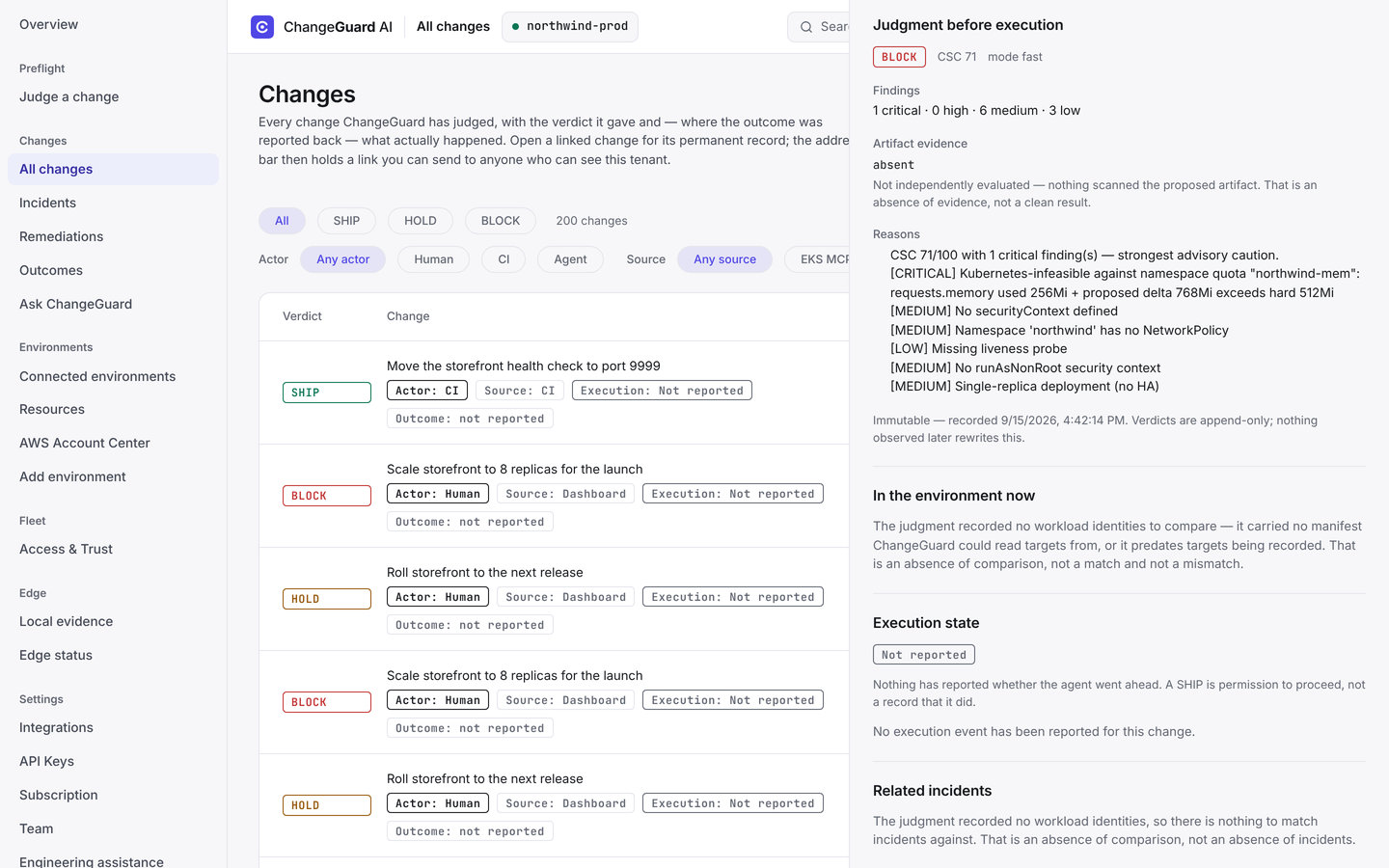
Judge a change by hand in Preflight, on every pull request through the GitHub App, or from any pipeline or agent with one call. The verdict carries plain-terms reasons, a readiness score, and an explicit list of the evidence it had and did not have. Absent evidence is never counted as safe.
- Live environment state where an environment is connected: what is running, what it can afford, whether the change is feasible against quotas and limits
- Artifact evidence when you supply a digest; an honest "not available" when you do not
- Verdicts are append-only and kept with the outcome on one permanent change record
- The Engineering Advisor adds the one or two things a senior engineer would raise from what is live in the environment right now, and stays silent otherwise. Professional and Enterprise. Live-proven
A Permit for every action
Authority is a per-environment decision, never account-wide. Advise is the default: a signed-in person approves each change, and that approval becomes the Permit. Auto produces a Permit only inside an explicit policy you wrote (namespaces, fix types, a confidence floor, an hourly cap) and falls back to Advise outside it.
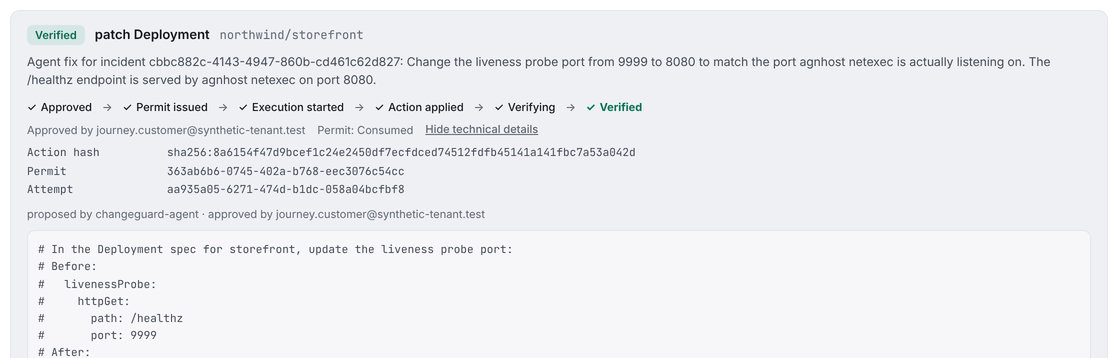
- Every authorization becomes a ChangeGuard Permit: signed in AWS KMS, bound to the exact action, expiring in minutes, used once
- Revocable until the moment it is consumed; a changed proposal, a changed policy or a withdrawn approval revokes it
- Auto never authorizes under an empty or default policy; it fails closed
Two Executors, one Permit model
Both verify the same signed Permit, consume it exactly once before touching anything, record the pre-state, apply one patch, and report the result under the Permit's identity.
Cloud Executor
Runs in ChangeGuard AI's estate. For each Permit it assumes an execution role in your account that carries no AWS service permissions, mints a 60-second token bound to exactly this cluster, and patches only the workloads in the namespaces you chose. Nothing to install; Edge is never required.
Local Executor
Installed in your cluster when your topology or policy requires local presence, with its own service account and a namespaced get, list and patch grant, never the Edge collector's identity.
Verify execution access proves the path before it is used: the Executor assumes its role, authenticates to exactly this cluster, holds get, list and patch in your namespaces, and is denied delete, create, exec, Secrets, impersonation, RBAC writes and cluster-admin. It verifies a signed probe Permit without reading or changing any workload.
What happened afterward
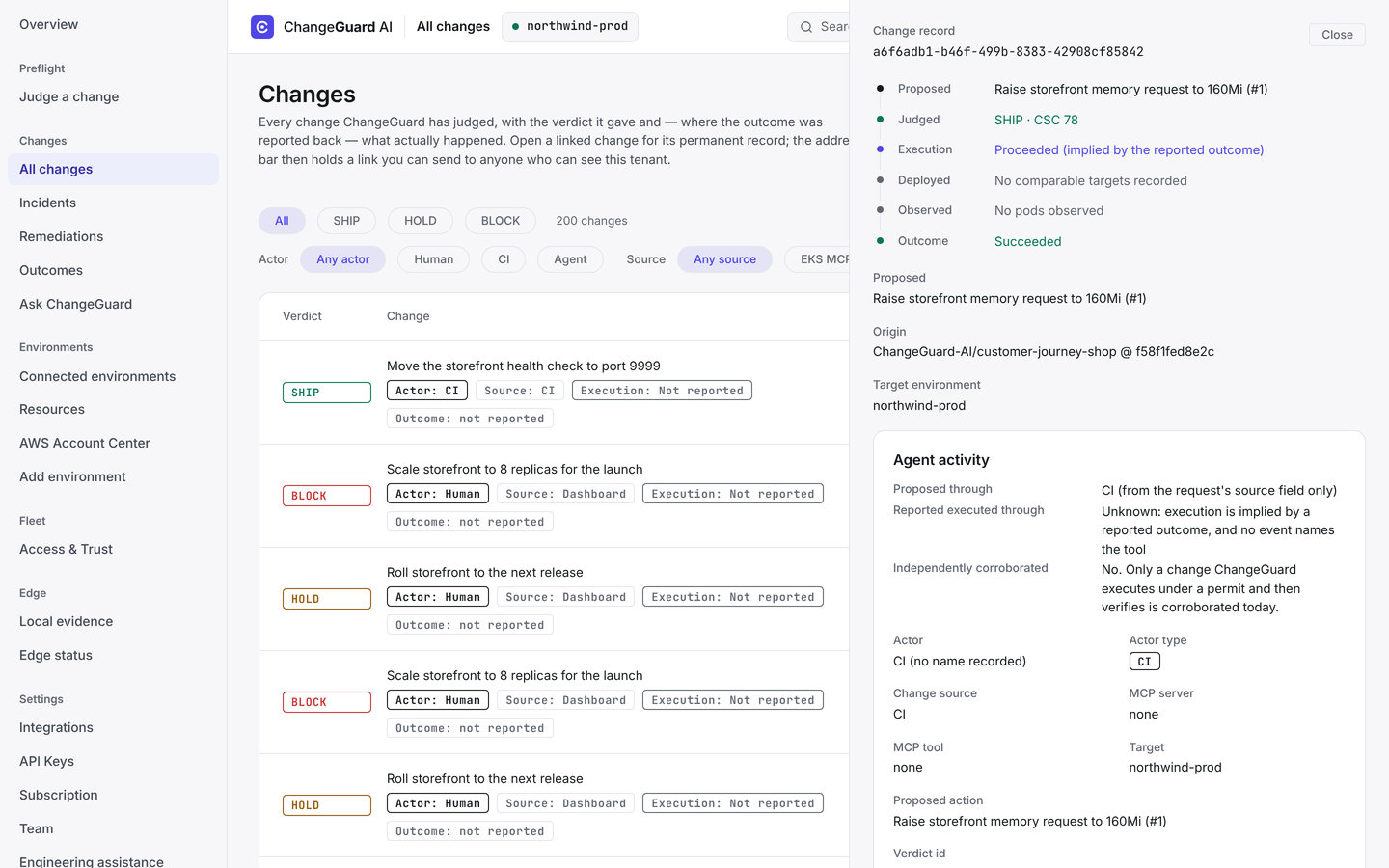
After a change executes, ChangeGuard AI records what actually happened against the change that caused it. Incidents are attributed to the exact change and investigated with cited evidence. Fixes are verified against fresh evidence, and a fix that fails verification is handed to a person: failure escalates, it never loops.
- Outcome attached by the verdict and Permit it named, never by recency
- VERIFIED only from an independent observation showing the permitted state, healthy
- Permanent, shareable change records; an append-only audit trail with the approver, the policy version and the Permit on every action
- Measured outcomes: predicted versus observed, joined by change identity
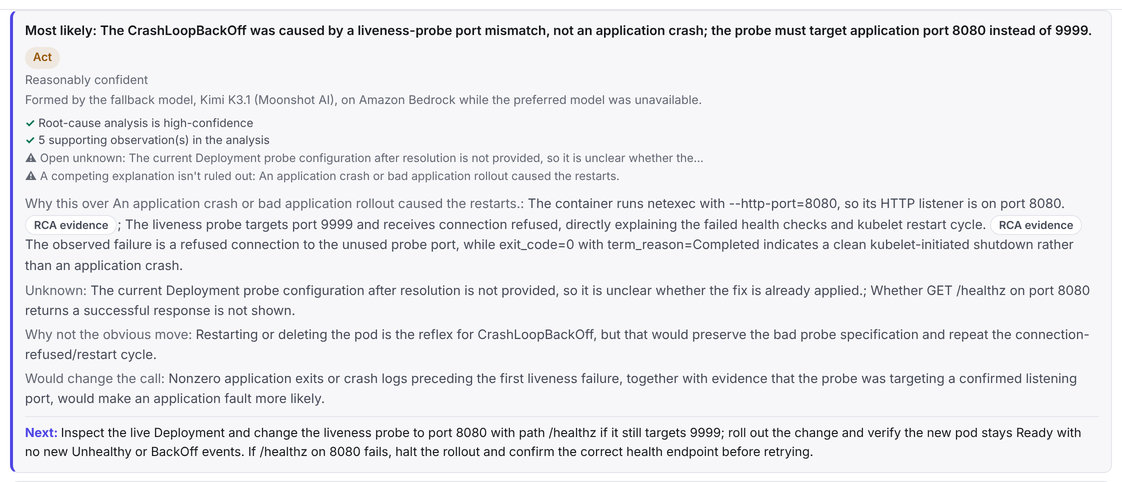
- Root cause with cited evidence, and an owned Engineering Opinion: the most likely cause, its confidence and reasoning, what would change the call, and what your workspace has seen before. Live-proven
- A shared incident workspace: one conversation, an accountable owner, a decision log, and an AI participant that answers when mentioned and never executes anything. Live-proven
- The Code Graph connects a change to the code behind it, built in your own cluster; only the graph leaves. Opt in per install. Live
Prerequisites: the Engineering Advisor, Opinion, Reasoning and Experience come with the Professional and Enterprise plans, on by default, and an admin can turn each off in Settings. The Advisor needs a connected environment with live evidence. The incident workspace is on every plan; its AI participant needs Professional or Enterprise. The Code Graph is on every plan and off until you enable it in your own Edge install; your source never leaves your cluster. Execution needs the per-environment grant you apply.
Evidence and action are separate planes
Fleet is the centralized evidence plane: connect your AWS account once, discover EKS clusters, authorize read-only access per cluster. Edge is an optional local-evidence extension. The Executor is the governed action plane. None of them grants another's authority.
AWS Account Center
Which AWS accounts ChangeGuard AI is connected to and whether each connection is healthy enough to discover and read your environments. Verify, discover, repair, reauthorize, without widening authority.
Connected Environments
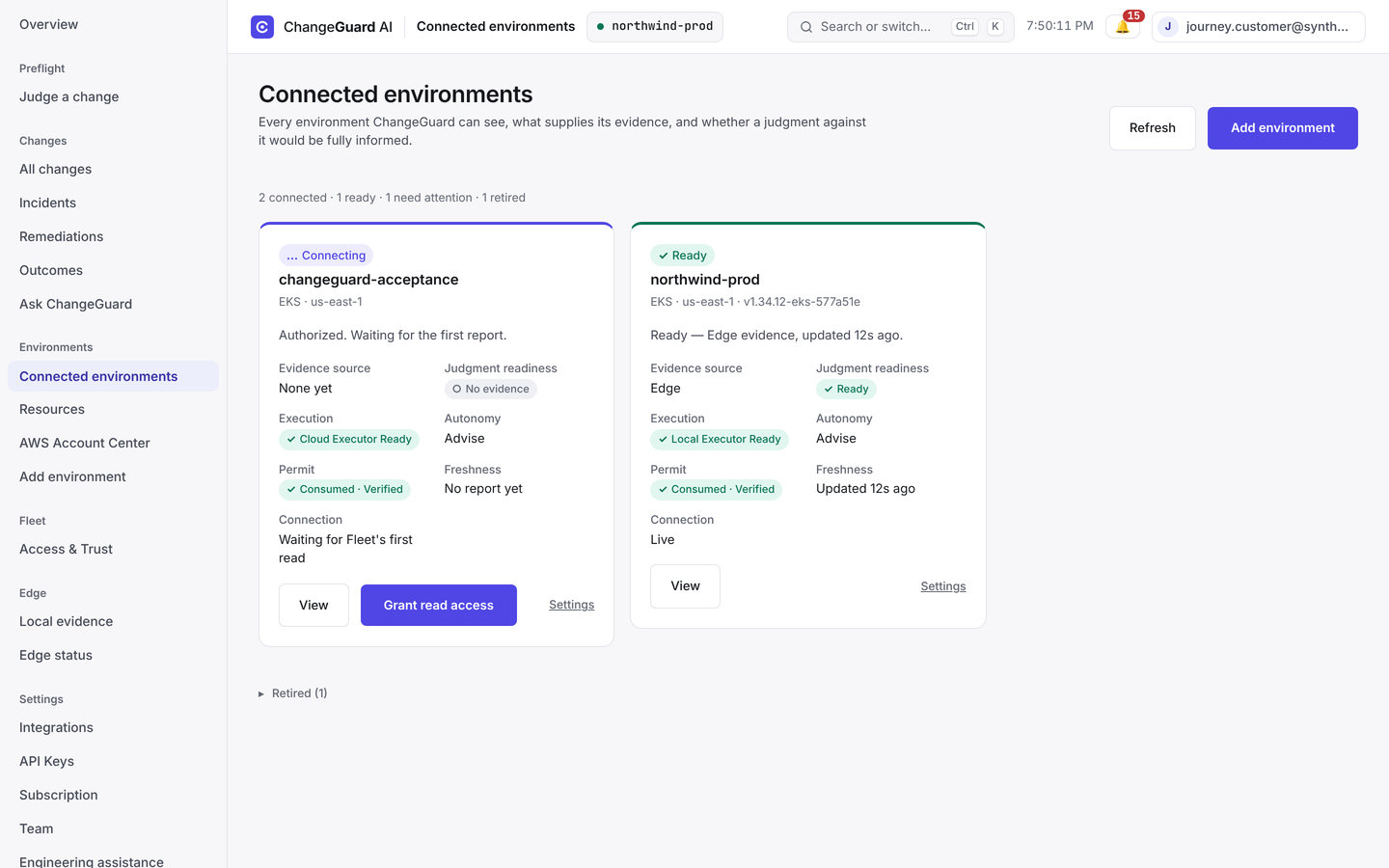
Every environment ChangeGuard AI can see: what supplies its evidence (Fleet, Edge or both), whether a judgment would be fully informed, its execution readiness, its latest Permit, and its Advise or Auto mode.
ChangeGuard Edge
A small read-only collector for evidence that needs local presence, such as runtime signals and node benchmarks, or for clusters that cannot be reached centrally. Optional. Never required for judgment or execution.
What is live, and what is next
Every capability is labeled, so what you evaluate is what you can turn on.
Engineering intelligence, generally available
The Engineering Advisor beside a verdict, and the Engineering Opinion with its Reasoning and your workspace's Experience on an incident. Generally available since November 2026. How it reasons →
Realms, SSO, self-hosted inference
Realms, a tenant split into production and test with separate authority, is designed and not built. SSO and SAML for app sign-in and self-hosted inference for judgment are planned. None of these ships today.
Governed change beyond Kubernetes
The same judgment, Permit and verification wherever a production change originates: Terraform, IAM, cloud resources, networking, databases. Direction, earned domain by domain on evidence. Not shipping.
ChangeGuard AI does not learn from every change today. Verdicts and outcomes are recorded so prediction can be measured against reality; no model, threshold, policy or prompt is modified by an outcome. Engineering Experience recalls your own workspace's recorded outcomes and similar incidents: retrieval, not retraining.
See it decide, then evaluate your own change.
A 14-day evaluation with no credit card, the public Lab with no account, or a walkthrough on the acceptance environment.